
Once upon a time…
Once upon a time, a well-intentioned Samaritan informed me that I have a robotic delivery when presenting ideas or connecting with people. That comment took up long-term residence in the background of my thoughts, and I became determined to do something about it. One day, feeling bored and looking for something new, I thought of checking what night classes were available at the nearby Stanford University. Before long, I came across a course titled The Art of Effective Storytelling at Stanford’s Continuing Studies Program. The title was intriguing enough (who doesn’t want to be a good storyteller?!), and I thought, It’s Stanford, after all—how bad can it be? Without further research, I pulled out my credit card and signed up.
The first class was nerve wracking. Our teacher, Dr. Marianne Neuwirth, asked each student to standup and silently stare into the eyes of every breathing soul in the room (almost 30 aspiring story tellers)before sharing their motivation for taking the class. What kind of a psychopath would silently stare into the eyes of strangers? I thought, but I decided to trust the process. When it was my turn, I managed to nervously shift my gaze to each classmate, but I was so anxious that my brain didn’t register anything. I then mumbled a few generic sentences about improving my communication skills and quickly sat down.
That day, I left class skeptical that it was the right fit for me. But over the next eight weeks, I learned, played, and connected with a remarkable group of people, making it one of the best experiences I’ve had in 2024. In this post, I’ll summarize the key takeaways and give a preview of what this class is like for prospective storytellers.
What makes a good story?
If I had to describe the objective of the course in one sentence, it would be: learning how to tell captivating stories in as few words as possible. Throughout the course, my fellow students and I had to tell structurally complete stories in two minutes or less. Our final assignment was to tell a personal story about the concept of home in forty-five seconds. I invite you to try timing yourself while telling a story about a recent event. It turns out it’s incredibly difficult to say anything meaningful in forty-five seconds. However, by the end of the course, I was surprised by the amount of emotion and information you can communicate to an audience if you apply the skills we learned. In the next few paragraphs, I describe four main concepts I learned in the class that helped me improve my storytelling efficiency.
First: “Rules are what make art beautiful” Aaron Sorkin
We tend to believe that art is the space where we ditch rules and allow our most chaotic thoughts to express themselves, but the reality is that rules are what make art beautiful. The story writing community has organized the rules (or structures) of what constitutes a good story in several models. One of these models is Kenn Adam’s popular Story Spine model.
The Story Spine is a tool that really brings narratives to life. It all kicks off with “Once upon a time…” to set the scene. Then comes the twist with “But one day…”, shaking things up and introducing a conflict. Because of that, a chain of events unfolds, leading us to the climax with “Until finally…”. And in the end, “And ever since then…” wraps it all up, showing how everything has changed. It’s such a simple yet powerful way to craft stories that truly resonate.
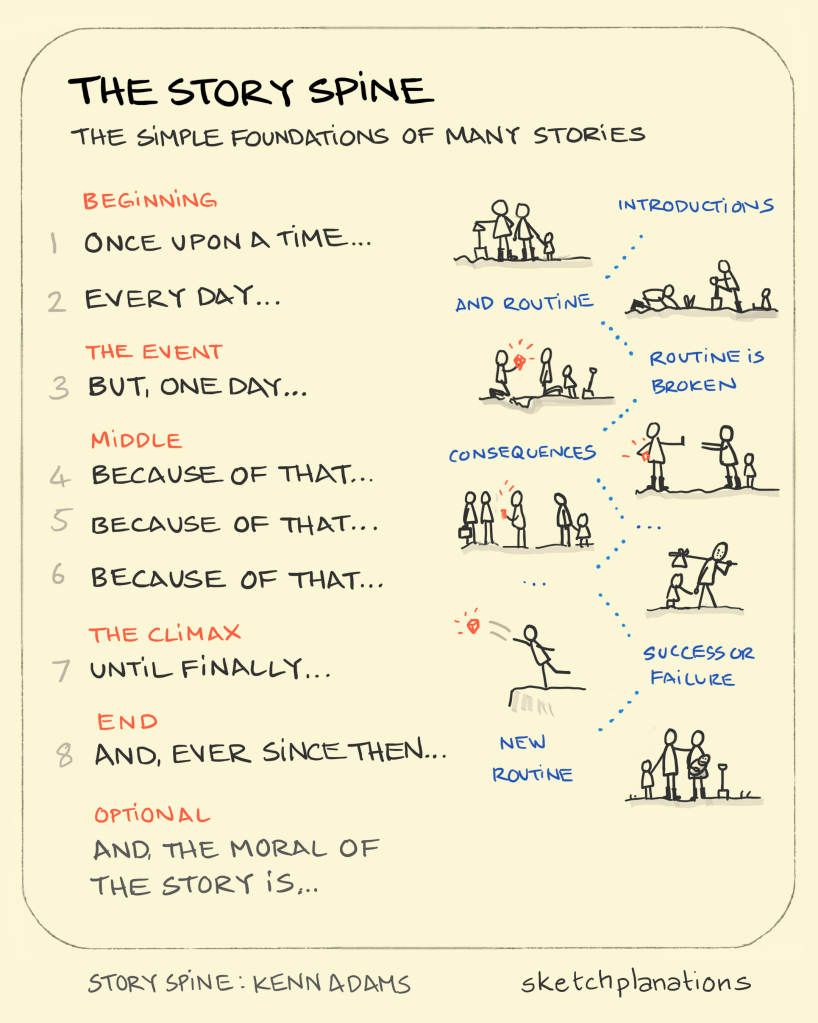
After learning about the Story Spine, I started seeing it in many of the literary works that I have known for years. One of my favorite Johnny Cash songs, “The Ballad of Ira Hayes”, is a great example of a story that flows according to this model.
Let’s see how this song adheres to Adams’ model:
- Once upon a time… Ira Hayes was born into the Pima tribe in Arizona.
- Every day… He lived in poverty, facing discrimination as a Native American.
- But one day… He joined the Marines and helped raise the flag at Iwo Jima, becoming a war hero.
- Because of that… Hayes returned home, but struggled with fame, racism, and trauma.
- Until finally… He fell into alcoholism and died tragically.
- And ever since then… His story symbolizes the neglect of Native American veterans and remains immortalized in the song.
The Story Spine and similar models are tools that simplify the task of telling stories that capture the audience attention. They are not mandates to be followed to the letter but general guidelines for the story flow. I have personally found it much easier to write my story assignments after I learned the Story Spine. That’s not to say that there aren’t extraordinarily captivating stories that don’t follow these models, but AFAIK they are the exception.
Second: Tell Your Story While Hopping on One Leg.
Good storytelling is not only about writing a good plot. Good delivery makes the difference between an engaged and bored audience. The main goal of storytelling is connecting with the audience, and whether we like it or not, these subtle verbal and non-verbal cues are essential to establishing that connection. Our day-to-day communications are plagued with bad habits that impede the effective delivery of a story. Most of us sprinkle filler words like ‘Um…’ and ‘So…’ all over our speech. We might forget to make eye contact with the audience or only make eye contact with one part of the audience.
I found this part especially difficult to reverse. No matter how much I told myself that I wouldn’t use ‘Um…’, it was very difficult not to fall back into autopilot and repeat old patterns. Add nerves to that, and it becomes like climbing a steep hill. I won’t dive into what habits should be cultivated to improve delivery skills; there is a plethora of resources that cover that. But I would like to highlight that this part of storytelling requires a lot of practice and self-monitoring.
Luckily, Dr. Marianne Neuwirth had a non-conventional approach that made practicing these skills in front of a crowd an extremely joyful process. She had one student tell his story while hopping on one leg; another recited poetry lying on the floor and staring at the ceiling; a third told a story while being almost carried by his classmates.
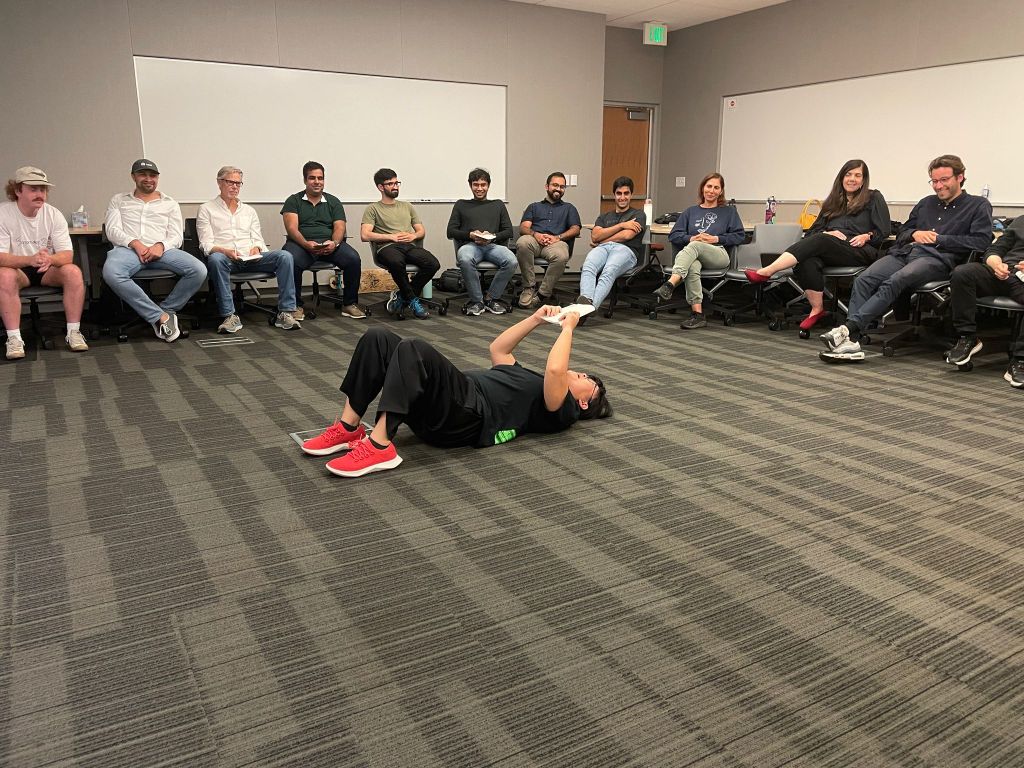
While the real purpose of this exercise is still a mystery to me (it could have been the teacher’s way to fulfill a sadistic desire to see the students humiliate themselves 😁), it felt like an attempt to normalize silliness, improvisation, and getting the students out of their heads to connect with their real voices. Nonetheless, that class was absolutely hilarious, and it’s worth taking the course just for the fun we had that day.”
Third: Cut The Fat!
Effective storytelling involves removing all unnecessary details that don’t enhance the narrative. While this might seem straightforward, I found it more challenging than I initially thought. By cutting out superfluous elements, you show trust in the audience’s ability to infer and deduce. Audiences enjoy using their imagination to fill in the gaps, and that’s when you know you’ve truly engaged them.
The strictly timed storytelling assignments we were given provided an excellent challenge and exercise in “cutting to the chase.” Each time, I found myself starting with a lengthy essay but gradually removed bits and pieces, like a sculptor chiseling a block of stone into a vivid piece of art. I would end up with a concise narrative that effectively delivers the essence of the story.
Fourth: Lather, Rinse, Repeat …
Becoming a good storyteller requires a lot of practice! While this might sound obvious to some, I had always assumed that good storytellers are born with exceptional communication skills. Although it’s true that some people are naturally more gifted than others, most good storytellers practice diligently and maintain a repertoire of stories they can share at any moment.
This course gave me the opportunity to see firsthand how thorough preparation and diligent practice can enable even the most awkward storyteller to deliver a strong performance. Given my history with social anxiety, I thought I would never be able to tell stories in front of 30 people. However, I spent hours preparing and practicing the stories I wrote, and despite my anxiety, being well prepared allowed me to control my nerves and deliver two well-received performances.
And The Morale of The Story Is…
COM-120 was the first class I ever took at Stanford Continuing Studies. Not only did it introduce me to the art of storytelling, but it also gave me the chance to share and listen to stories from a group of amazing people.
We shared stories about the origins of our names, childhood dreams, the loneliness of living away from family, the moments we realized we had met our soulmates or found our life’s purpose, and the power of community to overcome tragedy. Listening to people being vulnerable and sharing tough and joyful moments from their lives gave me a deep sense of connection to my classmates and renewed my connection to my humanity—which we can easily lose touch with in the daily hustle of Silicon Valley.
Since COM-120, signing up for Stanford Continuing Studies classes has become my new hobby, thanks to COM-120, Dr. Marianne Neuwirth, and my amazing classmates who opened my eyes to this treasure.
A Story Sample
The following is the story that I told the class for my first assignment. I decided to write about my childhood dream of becoming and astronaut, and how it almost lead to tragedy.
……..
As a kid, I was obsessed with space technology, and my dream was to become an astronaut. One day, I decided to build a model space shuttle using a large piece of cardboard I brought home from school.
I spent the next few hours cutting, folding, and molding until I had what seemed to me like a masterpiece. I was so proud of my work that I felt it needed to fulfill its destiny of flying. But there’s no real rocket launch without a big fire, so I decided to set the bottom of my space shuttle on fire and throw it from our third-floor balcony.
I was overjoyed as I watched my masterpiece sway left and right with the wind while slowly descending—until it landed on our neighbor’s balcony. My first reaction was panic, but I decided to pretend nothing had happened and went back to my room. Five minutes later, we heard people screaming and fire engines blaring.
Apparently, the neighbor’s curtains had caught on fire from my fiery masterpiece. Luckily, the damages that day were minimal, except for my ego and belief in my destiny of becoming an astronaut. The moral of the story: “Keep your dreams flexible; you never know when you will set the neighbor’s house on fire.” 😂

 hartakat.com
Leave a comment